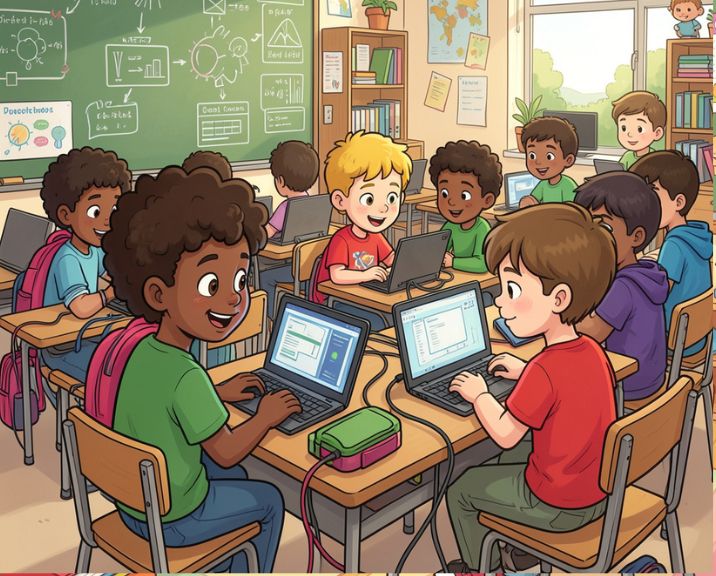
Embracing the Digital Age (Technology in Education)
Think about just how different school life looks today compared to ten years ago. Students today no longer depend only on books. A quick search can answer a question, a science concept can come alive through a virtual experiment, and a difficult maths topic can become easier with an interactive app. Thus, technology has managed to become a part of how children learn every single day.
However, here is a key point: technology doesn’t aim to replace teachers or classrooms; it simply makes learning more exciting and more flexible.
At The Manthan School, Greater Noida West, we see technology as a helping hand. It supports teachers, sparks curiosity as well as gives students the confidence to explore, ask questions, and discover things beyond the classroom walls.
The World Is Changing & So Should Learning
Let’s face it. The world our children are growing up in looks very different from the one we knew. Artificial Intelligence, automation, coding, digital communication, these are no longer “future” skills. They’re already here.
Schools today have a much bigger responsibility than simply preparing students for exams. They also need to prepare them for life.
However, there is still a very long way to go.
According to UNICEF, around 600 million children across the world are still not reaching minimum reading and mathematics levels, even though almost two-thirds of them are already in school. That’s a reminder that being present in a classroom doesn’t always mean every child is learning.
The challenge doesn’t stop there. UNICEF also shares that the world needs 44 million more teachers across primary and secondary schools, along with 6 million more early childhood educators, to meet today’s educational needs.
Then comes another reality. Nearly 1.3 billion children, about two-thirds of the world’s school-age population, still don’t have internet access at home. Whenever we talk about digital education, we also need to remember that millions of children are still waiting for that opportunity.
These numbers show why technology matters. At the same time, they remind us that it has to reach every child, not just a few.
Technology Doesn’t Replace Teachers, It Makes Them Even Stronger
One thing often gets misunderstood. Some people think that once students have tablets, laptops, or smart boards, learning automatically becomes better.
It doesn’t.
UNICEF explains that simply handing out devices or turning books into PDFs doesn’t improve education on its own. Technology works only when teachers know how to use it properly. The screen can only present facts but cannot comfort a child after a bad day, answer unexpected questions calmly, or rejoice in the little victories of a child.
That’s why teachers will always be the heart of education.
Learning Doesn’t Stop After the School Bell
One of the biggest advantages of technology is that learning can continue whenever students want.
Missed a lesson? Watch it again.
Need extra practice before a test? Log in and revise.
Curious about something beyond the syllabus? Explore it online.
Online learning platforms make all of this possible. They give students the freedom to learn at their own pace while still staying connected with their teachers as well as classmates.
A Library That Fits in Your Pocket
Libraries have always been magical places. Digital libraries simply make that magic easier to reach.
Students no longer need to search shelf after shelf. They can instead find different types of e-books, journals, research articles, and learning videos in no time. Regardless of whether they are working on a school assignment or simply looking for interesting topics out of curiosity, they can get whatever information they need quite easily today.
The more children read, the more they question, explore, and grow.
Learning Feels Better When It’s Fun
Honestly, every student enjoys learning more when it feels interactive.
A science simulation, a history quiz, a language app, or even an educational game can turn an ordinary lesson into something students actually remember.
When children actively take part in classroom activities instead of just listening, they develop better understanding of the concepts. They ask more questions, make more connections, and find the learning process much more enjoyable.
Sometimes, the smallest interactive activity creates the biggest “Oh, now I get it!” moment.
Every Child Learns Differently
No two students learn exactly the same way.
Some understand concepts the first time. Others need a little more practice. That’s perfectly normal.
Digital learning tools help teachers understand where students are doing well and where they may need a little extra support. By looking at learning patterns and classroom progress, teachers can guide students in a much more personal way.
Though technology provides useful information, it is still the teacher who knows how to turn that information into meaningful learning.
Looking Ahead
Technology will keep changing. New tools will arrive. New careers will appear. Learning itself will continue to evolve.
Recognised among the best schools in Delhi NCR, The Manthan School, Greater Noida West, believes that education is not about filling classrooms with gadgets. It is about helping children think critically and analytically, communicate effectively and develop the ability to learn throughout life.
Because at the end of the day, technology is only an enabler.
The real difference is made by inspired teachers, curious students, supportive parents, and a school that brings all of them together in one place and that’s exactly how we prepare children not just for tomorrow’s careers but also for tomorrow’s world.