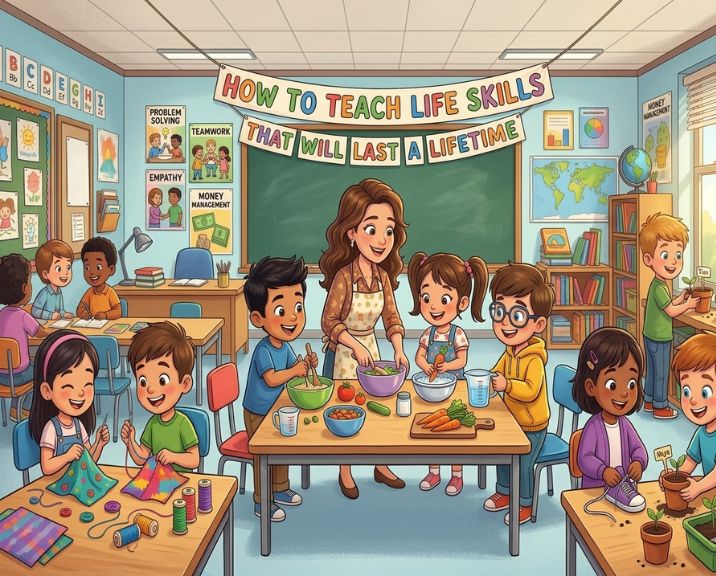
How to Teach Life Skills That Will Last a Lifetime
Life skills are just as important as academic knowledge because they help students handle real-life situations with confidence and responsibility. While subjects like mathematics and science build intellectual ability, life skills shape character, decision-making, and relationships. When students learn these skills early, they grow into balanced individuals who can manage challenges, communicate effectively, and make thoughtful choices.
Although these abilities develop gradually, consistent guidance from parents and teachers can help students practice them in everyday life. At The Manthan School, Greater Noida West, educators believe that nurturing such skills helps students become capable individuals who are prepared for the future.
Below are seven important life skills that students should learn, since they support personal growth and long-term success.
1. Being Fully Present
Being present means paying attention to what is happening around us rather than getting lost in our thoughts or distracted by devices. When students truly focus on the moment, they are able to listen carefully, understand others better as well as respond thoughtfully. Real connection happens when people genuinely listen and interact with one another, because meaningful conversations require attention and interest.
Students need to develop their ability to focus when communicating with each other, maintain eye contact as well as participate actively in discussions. Physical presence is important, but so is being mentally engaged because it helps students understand others better and build meaningful relationships.
2. Making Thoughtful Decisions
Whatever we consider to be important is reflected in every decision that we make. Students must therefore need guidance to think carefully before acting.
They will be capable of making better decisions when they know how to evaluate their choices and base them on consequences. This skill helps them not to act on impulse but to focus on what contributes to their goals and values. Over time, thoughtful decision-making builds confidence and responsibility.
3. Honouring Social Commitments
Strong relationships depend on reliability. When students promise to attend a meeting, participate in an activity, or support a friend, keeping that commitment shows respect and responsibility.
Participating in clubs, group projects, and community activities gives students opportunities to practice teamwork. Although these responsibilities may sometimes feel small, they teach an important lesson: trust is built through consistent actions.
4. Communicating Clearly
Communication is an important factor in building relationships and conveying thoughts. In spite of the convenience of digital communication, face-to-face communication is not yet fully replaced since it enables people to interpret tone, expressions, and emotions.
Learners must, therefore, learn how to question, express their ideas in a presentable way, and listen to other people. Effective communication enables students to make friends, cooperate with others and feel free to express themselves.
5. Respecting Different Perspectives
As students grow, they meet different people of diverse cultures, backgrounds, and beliefs. Despite the possible differences in views, learning to respect these differences is an essential life skill.
Open-minded students are able to empathize and understand. They are taught not to dismiss ideas but to inquire and listen to other opinions. Such attitude encourages tolerance and also contributes to the establishment of harmonious relations.
6. Resolving Conflicts Calmly
Disagreements are a normal part of life. However, how students respond to conflict determines whether relationships grow stronger or weaker.
The students are to be taught to deal with any disagreements peacefully by letting other people talk, sharing their emotions in a respectful manner, and finding a solution together. Such a practice does not only solve issues but also strengthens trust and cooperation among peers.
7. Staying Hopeful in Difficult Times
Challenges and failures are inevitable in life, yet they also provide opportunities for learning and growth. Students who develop hope and optimism are more likely to recover from setbacks.
Hope does not ignore difficulties; instead, it encourages students to believe that situations can improve.
Conclusion
Life skills influence the way students think, act as well as relate to other people. While academic learning builds knowledge, these skills help students apply that knowledge wisely.
The Manthan School, Greater Noida West, a high school in Greater Noida West, focuses not only on academic excellence but also on helping students develop the practical skills needed for lifelong success. When students build these abilities early, they are better prepared to navigate challenges by themselves, form strong relationships, and contribute positively to society.