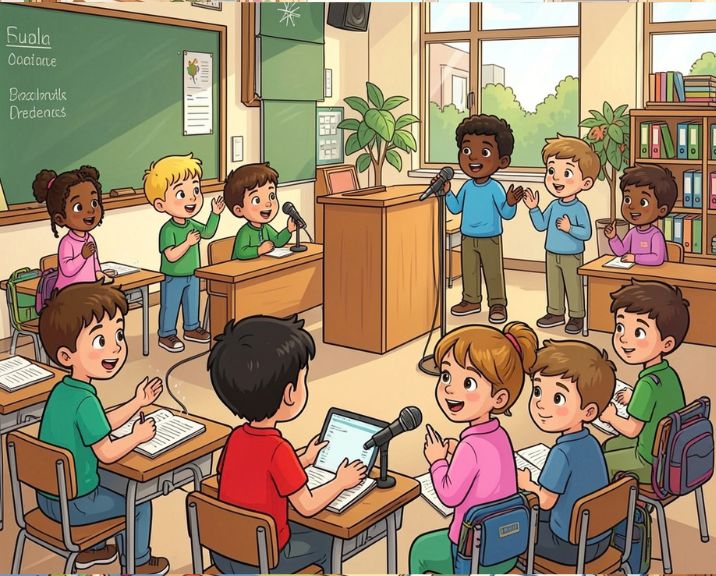
Beyond Worksheets: The Manthan School Noida Turns Curiosity Into Meaningful Learning
Walk into a lot of pre-primary and early primary classrooms and you’ll see the same thing: stacks of worksheets, tracing letters, filling in blanks, colouring inside lines. It’s the easiest thing for a school to point to when a parent asks what their child did that day. A worksheet is proof of work. But is it proof of learning?
This is a genuine question, not a rhetorical one, and it’s worth answering directly rather than dodging it. Worksheet-based learning isn’t harmful in small doses. Children do need some practice with fine motor control and basic recognition tasks. The problem shows up when worksheets become the primary method rather than a small supporting piece, because a worksheet mostly tests whether a child can repeat something, not whether they understand it or can apply it somewhere else.
At The Manthan School in Noida, the early years and primary curriculum is built around a different starting point. Instead of asking “can the child fill this in correctly,” the approach asks “can the child construct meaning from this on their own.”
Why Worksheets Alone Fall Short for Young Children
Young children learn primarily through doing, touching, moving, and talking, not through sitting still and completing a printed page. A worksheet can confirm that a five year old recognises the letter B, but it can’t tell you whether that child can use language to describe what they see, solve a small problem with a peer, or make sense of something new in their environment. Those are the skills that actually predict how well a child adapts to bigger academic demands later on.
There’s also a quieter cost to leaning too heavily on worksheets. Children who spend most of their classroom time completing repetitive printed tasks get less practice at the kind of open-ended thinking that builds curiosity. They learn to look for the one right answer rather than to explore a question from a few different angles. For early years especially, that trade-off matters.
How The Manthan School’s Pre-Primary Curriculum Is Structured Instead
At The Manthan School’s Noida campus, the pre-primary curriculum is built around themes rather than isolated worksheet tasks. Different areas of the curriculum are connected and integrated within a theme, so a single topic gets explored through language, art, movement, and observation together rather than through a single subject in isolation.
The school names five specific areas it aims to build in early years: speech and language skill, pre-math skill, relating to the environment, cognitive development, and sharing and caring for self and others. Notice that only one of these, pre-math skill, looks anything like what a worksheet typically measures. The rest depend on interaction, conversation, and experience, things a printed page simply can’t capture or build on its own.
The curriculum also follows what the school describes as an inquiry approach, where children construct meaning using what they already know alongside new information gained through the learning process itself. That’s a fairly precise way of describing the opposite of worksheet learning. Instead of being handed an answer to fill in, children are expected to work toward understanding through their own exploration, guided by a teacher rather than directed by a printed sheet.
What Continues Into Primary School
This approach doesn’t stop once a child moves past pre-primary. The Manthan School describes its primary programme as a child centric, integrated learning model, where the goal is measurable improvement in cognitive skills rather than task completion. The curriculum is designed so that different learning layers build on each other within a grade, and assessment is structured to find learning gaps at a fairly detailed level, down to the sub-topic, rather than just checking whether a worksheet came back correctly filled in.
In practice, this means a child is expected to connect new material to what they already know and reason through it, not simply reproduce it. That’s a meaningfully different bar than “did the child complete the page.”
What This Means If You’re Comparing Schools
If you’re weighing whether a school’s approach to early learning is worksheet-heavy or genuinely built around understanding, a few questions tend to reveal the answer quickly. Does the curriculum name specific developmental areas beyond academic content, or does it only talk about subjects? Is learning organised around themes that connect subjects together, or are subjects taught in isolation through repeated printed exercises? Does the school describe how it identifies where a child is actually struggling, or does it only describe how much work gets assigned?
At The Manthan School Noida, the answers point toward a curriculum designed around inquiry and connected themes, with worksheets playing a supporting role rather than being the main method of teaching and assessing young children.
See the Classrooms and Curriculum Yourself
Descriptions only go so far when it comes to judging how a curriculum actually plays out day to day. If you’re considering pre-primary or primary admission in Noida Sector 78, the clearest way to judge The Manthan School’s approach is to visit a classroom and see how a themed activity or inquiry session actually runs. You can learn more about The Manthan School Noida’s curriculum at themanthanschool.co.in/noida, or get in touch through the school’s admission page to arrange a visit.