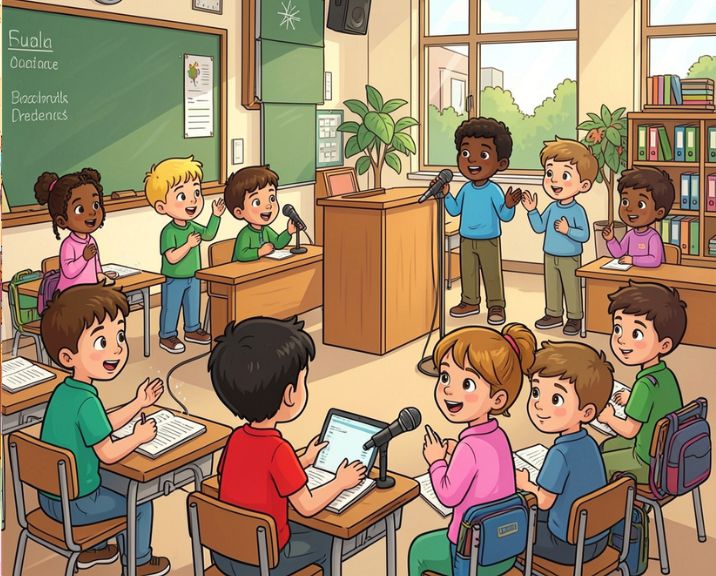
How to improve speaking skills in school
A child may know the answer but still hesitate to raise a hand.
Another student may have a good idea but struggle to explain it to classmates. Some children speak comfortably with friends but become quiet when asked to speak in front of a group.
These situations are common because speaking is a skill that develops with practice.
Children need opportunities to find the right words, organise their thoughts, listen to others and gradually become comfortable expressing themselves. This is why speaking skills should not be limited to occasional speeches or language classes. They can be developed naturally through everyday classroom interaction.
Speaking Is Not Just About Talking
When we talk about improving speaking skills, it is easy to focus only on pronunciation or fluency.
Effective communication involves much more.
A child needs to learn how to:
- Express an idea clearly
- Listen before responding
- Choose words appropriate to the situation
- Ask questions
- Explain a point of view
- Speak at an understandable pace
- Respond to another person’s ideas
- Use appropriate tone and expression
- Participate in a conversation
This is why speaking and listening should be developed together.
The Education Endowment Foundation’s current evidence review describes oral-language approaches as including purposeful classroom dialogue, structured questioning, vocabulary development, reading aloud and interaction between teachers and pupils or between peers.
The Quiet Child Does Not Necessarily Lack Communication Skills
One important thing for teachers and parents to understand is that being quiet is not the same as having poor communication skills.
Some children need more time before they feel comfortable speaking in front of others. Others may communicate confidently in pairs but hesitate in a large group.
Instead of forcing every child to speak in exactly the same way, schools can provide different levels of participation.
A child might begin by:
speaking to a partner → participating in a small group → answering in class → presenting to the whole class.
This gradual progression can make speaking practice less intimidating.
Give Children Something Worth Talking About
Children usually speak more naturally when they have something meaningful to say.
Rather than repeatedly asking students to “speak in English” or “speak clearly”, teachers can give them a reason to communicate.
For example:
Look at this picture. What do you think happened before this scene?
Your group has to decide which solution is better. Explain why.
You have two minutes to explain something you learned this week.
What would you change about this story?
These questions make speaking part of thinking and learning.
EEF evidence particularly supports purposeful, curriculum-focused dialogue rather than treating oral language as something completely separate from classroom learning.
Try the “Think, Talk, Share” Approach
A simple classroom routine can make a major difference.
Think
Give students a little time to form their answer.
Talk
Let them discuss the idea with a partner.
Share
Invite selected students to share their thinking with the class.
This is particularly useful for children who need more time to organise their thoughts.
Instead of immediately asking a student to answer in front of 30 classmates, the teacher first gives them an opportunity to rehearse the idea with one other person.
The final answer can then become more organised and confident.
Use Storytelling Instead of Memorised Speeches
Storytelling gives children a natural reason to speak.
A teacher can show a picture and ask students to create a story around it.
For younger children, the story can be very simple:
Who is there?
Where are they?
What happened?
What happened next?
How did the story end?
Older students can retell stories from different perspectives or create an alternative ending.
Manthan has previously used storytelling sessions where children participated in discussions following the stories, with the school specifically noting benefits for verbal proficiency and listening skills.
Show and Tell Has a Real Educational Purpose
For younger learners, Show and Tell can turn a familiar object into a speaking activity.
A child can bring a favourite book, toy, drawing, photograph or another suitable object and explain:
- What it is
- Why they chose it
- Where it came from
- What they like about it
- What others should know about it
The CBSE National Curriculum Framework for the Foundational Stage recommends Show and Tell opportunities for children and describes the activity as supporting public speaking, listening, communication and interaction.
The important part is not the object.
The important part is that the child has a real reason to speak.
Reading Aloud Should Be More Than Pronouncing Words
Reading aloud can help students practise pronunciation and fluency, but it can become much more useful when teachers also work on expression.
Students can be encouraged to notice:
- Where to pause
- Which words need emphasis
- How a character might sound
- How punctuation changes delivery
- When the voice should become softer or stronger
After reading, the teacher can ask students to explain what they understood rather than simply checking whether every word was pronounced correctly.
This connects reading, speaking and comprehension.
Let Students Ask Questions Too
Speaking development should not mean that the teacher asks all the questions.
Students should also learn how to ask useful questions.
After a lesson, a teacher could ask every student to prepare:
One thing I understood
One thing I found interesting
One question I still have
This encourages children to use spoken language to explore their own curiosity.
It also changes the classroom from a place where students only respond to questions into a place where they can initiate conversations.
Use Pair Work Before Public Speaking
Not every speaking activity needs an audience of the entire class.
Pair work can be particularly useful for children who are hesitant speakers.
A teacher might ask two students to discuss a topic for two minutes and then choose one idea from their conversation to share.
This gives students a chance to practise the language before speaking publicly.
Over time, the same technique can be expanded into:
pairs → small groups → classroom discussion → presentation.
This creates multiple levels of speaking practice within the same lesson.
Give Students Real Situations Through Role-Play
Role-play can make communication practice more realistic.
Instead of simply asking students to speak on an abstract topic, give them a situation.
For example:
A new student has joined your class. Welcome them.
You disagree with your friend’s idea. Explain your opinion politely.
You need help with something. Ask your teacher appropriately.
Your group has a problem. Discuss possible solutions.
Now students have to think not only about what to say but also how to say it.
That develops communication as a social skill rather than just a language exercise.
Teach Children to Listen Before They Respond
A conversation becomes difficult when everyone is preparing their own answer instead of listening.
Teachers can introduce simple listening habits:
- Do not interrupt.
- Look towards the person speaking when appropriate.
- Wait until the speaker finishes.
- Ask a follow-up question.
- Refer to something the other person said.
For example, instead of replying:
“I don’t agree.”
a student could learn to say:
“I understand your point, but I think…”
This small difference teaches children how to disagree while continuing the conversation respectfully.
Feedback Should Improve Speaking, Not Stop It
Correcting every mistake can make some children afraid to speak.
The purpose of feedback should be to help students improve without making them reluctant to participate.
Instead of interrupting every sentence, a teacher can identify one or two areas for improvement.
For example:
“Your explanation was clear. Next time, try speaking a little more slowly.”
Or:
“You had a strong idea. Try adding one example to support it.”
This gives the child a specific next step.
The same principle applies to pronunciation. Not every minor error needs to interrupt the flow of communication.
Build Vocabulary Through Conversation
Children sometimes know what they want to say but cannot find the words.
Vocabulary development can therefore be connected directly to speaking.
Suppose the class is learning about weather.
Instead of asking students to memorise a list of words, the teacher can introduce words such as:
humid, cloudy, forecast, temperature, storm
and then ask students to use them while discussing the day’s weather.
This gives vocabulary a purpose.
EEF’s evidence review specifically identifies extending pupils’ spoken vocabulary and using purposeful dialogue as examples of oral-language approaches.
Presentations Should Start Small
Public speaking does not have to begin with a five-minute speech.
Younger students can start with 30–60 seconds.
Possible topics include:
- My favourite book
- Something I learned
- My favourite game
- An interesting object
- A person I admire
- A place I would like to visit
Once students become comfortable, teachers can gradually introduce longer presentations and more structured topics.
This makes presentation skills a progression rather than a one-time activity.
How Technology Can Support Speaking Practice
Technology can provide additional opportunities for students to hear and practise language.
For example, students can record a short presentation and listen to themselves afterwards. They may notice that they speak too quickly, repeat certain words or become difficult to hear at particular points.
Language-learning technology can also provide pronunciation and listening practice.
At The Manthan School, the Digital Language Lab is designed to support pronunciation along with aural comprehension and oral and written proficiency, with interactive resources that allow learners to practise and progress.
Technology, however, works best as a support. Children still need real conversations with teachers and classmates.
How The Manthan School Supports Communication
The Manthan School’s current primary curriculum specifically states that language learning aims to help students communicate confidently in both oral and written forms. It also provides opportunities for learners to express and share ideas through teamwork and mutual support.
The school’s primary approach uses interactive and hands-on activities, with projects designed to encourage inquiry and independent learning. These activities naturally create situations where students need to explain, discuss and share ideas.
For younger children, Manthan’s early-years programme also identifies speech and language skills as one of the key areas of development, alongside cognitive development, pre-mathematical skills and social development.
So communication is not treated as something students practise only when they have a speech or presentation activity. It can be developed through the wider learning experience.
A Simple Speaking Practice Routine for Schools
A school does not need a completely separate programme every day to give students more speaking opportunities.
A simple weekly routine could look like this:
Monday — Think & Talk
Students discuss a lesson-related question with a partner.
Tuesday — Story or Read-Aloud
Students read or retell a short story.
Wednesday — Question Day
Students prepare and ask questions about the week’s learning.
Thursday — Group Discussion
Students work together to discuss a problem or topic.
Friday — Share
A few students present an idea, experience or piece of work.
The exact activities can change according to age and subject.
The important part is consistency.
What Parents Can Do at Home
Speaking development also benefits from ordinary conversations at home.
Parents can ask children to explain rather than simply answer.
Instead of:
“Did you have a good day?”
try:
“What was the most interesting thing you did today?”
Instead of:
“Did you understand the lesson?”
try:
“Explain the lesson to me in your own words.”
Parents can also talk about stories, ask children to describe objects, discuss everyday decisions and encourage them to explain their opinions.
Children do not need formal speech practice every evening. Regular conversation itself is valuable practice.
When Should Parents Be Concerned?
Every child develops communication skills at a different pace.
A child being shy in a particular situation does not automatically mean there is a communication problem.
However, if parents or teachers consistently notice difficulties with understanding language, expressing needs, being understood, following conversations or communicating across everyday situations, it can be useful to discuss those observations with an appropriate professional.
The important thing is not to compare one child with another.
The focus should be on the child’s own communication development and whether they are making progress.
The Goal Is a Confident Communicator, Not the Loudest Child
A strong speaker is not necessarily the child who talks the most.
Good communication means knowing when to speak, what to say, how to say it and when to listen.
A child who can explain an idea clearly, ask a thoughtful question, listen respectfully and respond appropriately is developing meaningful communication skills.
That is a much more useful goal than simply making children speak more.
Final Thoughts
Speaking skills grow through use.
Children need conversations, questions, stories, discussions, presentations, role-play and opportunities to explain their thinking. They need adults who listen to them and give them enough space to find their words.
The strongest approach is therefore not to create one isolated “speaking skills” lesson and expect instant confidence. Speaking can be woven into science, mathematics, language, projects, stories, group work and everyday classroom interaction.
At The Manthan School, a CBSE school in Noida, the child-centred curriculum, teamwork, oral communication focus and Digital Language Lab provide different settings in which students can practise language and express their ideas.
When children are given regular opportunities to think, listen, speak and respond, communication gradually becomes a natural part of learning and their confidence can grow along with it.