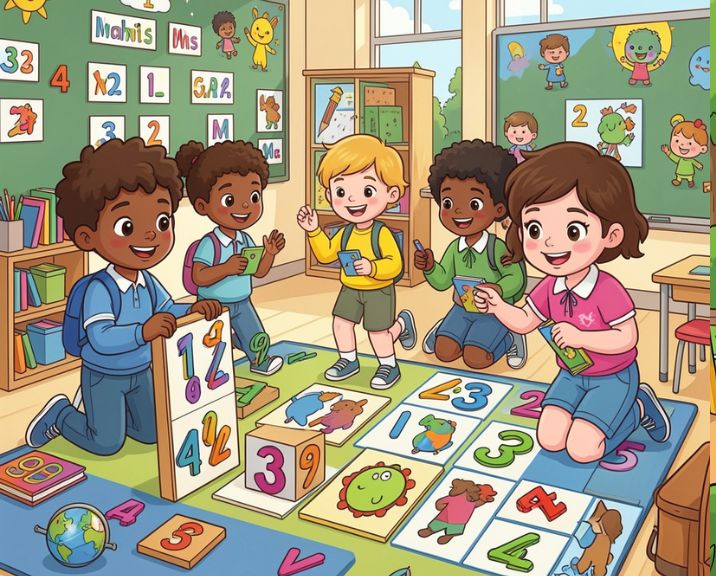
Number Sense Through Everyday Play
Teaching your child how to have a good understanding of numbers can feel like a daunting task, but they may already be learning some of these skills naturally every day without you even realizing it. And also, number sense doesn’t just mean knowing numbers or memorizing them; it also refers to the true understanding of a number and how it works in everyday life.
As a good example, if your child helps you set the table and notices that two plates are missing or they count how many spoons to put out for everyone, they are already practicing number sense. And again, comparing quantities, noticing patterns, or sharing toys fairly are all part of learning numbers naturally.
At The Manthan School, Noida, we believe children can develop these skills through everyday play, observation, and fun activities. Because when children explore numbers naturally, they not only enjoy learning but also start understanding math intuitively.
Why Is Number Sense Important?
Number sense is important because it helps children understand numbers in a real, concrete way. It’s not about memorizing “five” or “ten,” but about understanding what these numbers actually represent. And also, children who have good number sense can make logical guesses, solve problems, and understand relationships between numbers.
For example, knowing that 7 + 3 = 10 will help a child understand that 7 + 7 has to be greater than 10. This type of thinking builds a solid base for learning more complex concepts about the use of numbers as they continue to build on their foundation.
Children without number sense may find daily tasks harder, like telling time, measuring things, or even doing simple addition and multiplication. But again, the good news is that number sense can be developed through practice, games, and hands-on activities.
Here are some fun ways you can help your child build number sense at home.
Match the Quantities
What you’ll need: chart or craft paper, scissors, glue, paper cutouts of different items (like candy sticks, dots, teddy bears).
Start by placing two rows of items with different quantities. For example, four candy sticks in one row and five in another. Then ask your child to count the items and create a matching row with a different object.
So, they could place four red dots or four teddy bears below the first row. And also, repeat this for the next row. This activity teaches children that different objects can represent the same number. It’s hands-on learning and also very fun!
Roll and Move
What you’ll need: board game with numbers, dice, player figures.
Roll the die each time you play, and move your figure along the board as well. And also, encourage your child to count, estimate, or skip count while moving; this will give them practical experience with numbers.
You can also choose not to complete the entire game; just moving pieces and counting how many spaces each piece has moved will improve number sense and logical thinking.
Go on a Number Hunt
What you’ll need: paper, marker, tape.
Write numbers on separate sheets and hide them around the house. Then ask your child to find them in order. And also, you can add a timer for extra excitement.
It’s an enjoyable way for kids to practice counting and sequential number skills.
Number Box Fill and Find
What you’ll need: paper, marker, objects or LEGO bricks.
Create a 10-frame, which is a rectangle divided into ten squares. Call out a number, and ask your child to write it in the correct square. Then have them find that many objects or LEGO pieces.
This activity connects written numbers with real quantities. And also, children learn to place numbers correctly while physically counting objects, making the learning very concrete.
Everyday Play Builds Number Sense
Number sense is not just for school but it’s everywhere. Children learn to compare, count, and reason with numbers by performing ordinary activities such as cooking, grocery shopping, and setting the table.
By using games, charts, and playful exercises, children can gradually internalize the number system. They feel confident with numbers and which helps make later math lessons much easier.
At The Manthan School, Noida, as a trusted primary school in Noida, we strongly believe that learning through play is the key to developing strong number sense. Because when children enjoy learning, they remember more, think critically and approach math with curiosity, not fear.