
Published on: 11-08-2026
You're in the middle of the mall and your toddler just... falls apart. Not the usual "I want that toy" cry. Something bigger. Louder. Harder to pull them out of. Or it's the same shirt every morning, and getting dressed has somehow turned into a full-blown battle, again.
So which is it? A toddler being a toddler, or something a bit more specific, like a sensitivity to sound, touch, or crowded spaces that you haven't quite named yet? Parents ask us this a lot, and honestly, it's a good question to sit with.
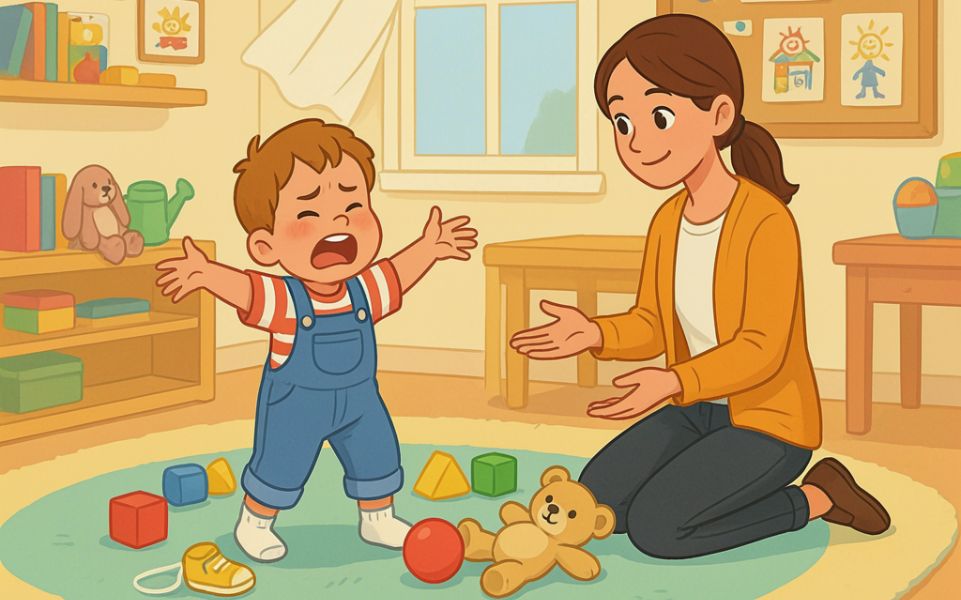
What a Regular Tantrum Usually Looks Like
Tantrums come with the territory of raising a toddler. Their words haven't caught up with their feelings yet, so it spills out as crying, screaming, sometimes flopping straight onto the floor in the middle of the aisle. A few patterns tend to hold up:
There's usually a reason you can point to. Told no. Had to leave the park. Sibling took the toy.
It shows up more on hard days, when your child's tired or hasn't eaten. Comfort or a little distraction often does the trick. You can talk them down, even if it takes ten frustrating minutes. A lot of it is your toddler testing what happens when they push back, which, annoying as it is, is a pretty normal stage.
And the good news? As their vocabulary grows, this usually settles down on its own.
What a Sensory Meltdown Tends to Look Like
Some kids just feel things harder. A sound that barely registers for one child can genuinely overwhelm another. This isn't your child being difficult on purpose. Their body's taking in more than it can sort through in the moment.
A few things to notice:
- It doesn't seem tied to anything in particular. One second fine, the next, gone.
- The same triggers keep coming back, a scratchy tag, a vacuum cleaner, a packed birthday party.
- Comfort doesn't land the way it usually would. Distraction barely touches it.
- Hands over the ears. Pulling away from a hug. Going rigid right before it hits.
- It keeps happening in similar places, supermarkets, crowded rooms, anywhere loud.
- Coming back down from it takes longer than a typical tantrum would.
- Sometimes there's rocking, avoiding eye contact, or trying to squeeze into a small corner.
If there's one line to hold onto: a tantrum is usually about wanting something. A meltdown is usually about feeling too much, all at once.
Why Some Kids Are Wired This Way
We usually talk about five senses, sight, sound, touch, taste, smell. But there are a couple of quieter ones doing work in the background too. One keeps your child steady when they jump or spin. Another helps them figure out how much force to use, whether that's a gentle pat or holding a crayon. And a third helps them notice what's happening inside their own body, like catching hunger or frustration before it turns into something bigger.
When one of these isn't quite working the way it should, ordinary things, brushing teeth, a busy grocery run, can feel far bigger than they'd look to anyone watching from outside.
Where Occupational Therapy Comes In
This is really the space occupational therapy works in. A therapist might use balance games or crawling exercises just to help a child get more comfortable in their own body. Breathing techniques come in before things spiral, not after. Swinging and other movement-based play help the nervous system settle. And slowly, gently, therapists work on building up tolerance to whatever usually sets a child off, sometimes leaning on things like weighted blankets or fidget toys along the way.
How Manjoli Child Development Centre Can Help
We keep parents in the loop through regular updates, work with trained therapists, and have the kind of setup built specifically for this sort of therapy, not adapted from something else.
At Manjoli Child Development Centre, an initiative of The Manthan School in Noida Sector 78, we've seen again and again that starting early makes daily life a lot lighter, for the child, and honestly, for the whole family.