
Published on: 16-09-2026
"Put your shoes on, grab your bag, and wait by the door." Simple enough, right? Except thirty seconds later your child is back to playing, shoes still nowhere near their feet, bag forgotten entirely. So you say it again. Slower this time. Maybe you even break eye contact to make sure they're really listening. And somehow it still doesn't land.
If this is a daily occurrence in your house, please don't assume your child just isn't listening. In most cases, something else is going on, their brain is holding onto instructions differently than we'd expect, and that's a very different problem than "not paying attention."
It's draining for parents. But think about how it feels from the child's side. They want to get it right. They're trying. And somewhere between hearing you and actually doing the thing, the instruction just... slips away.
What's Actually Happening When Instructions Don't Stick
Following an instruction seems like nothing, but it's actually asking a lot of a young brain all at once. First they hear the words. Then they have to hold onto them. Then make sense of what's being asked. Then act on it, often in a specific order if there's more than one step involved.
That "holding onto it" part relies on working memory, basically, the mental sticky note we use to keep information around just long enough to use it. For some kids, that sticky note is smaller than average, or it just doesn't hold as well. One instruction on its own? Fine. But add a second step, or some background noise, or a two-second distraction, and the first part of what you said has already fallen off before they get around to using it.
This isn't defiance. It's not laziness either, whatever it might look like from across the room. It's a real difference in how information gets processed, and it's a lot more common than most people realize.
Here's the part that worries us most, though: if nobody catches this early, it snowballs. Teachers start describing the child as inattentive. Parents start wondering if they're just being difficult. Meanwhile the child needs something else entirely, a different way of receiving and practicing instructions so the information actually sticks.
How Special Education Rebuilds This, Step by Step
At Manjoli Child Development Centre, an initiative of The Manthan School in Noida Sector 78, this is exactly the kind of challenge special education is built to address. And the starting point isn't "try harder to remember." It's teaching instructions in a way a child's brain can actually hold onto.
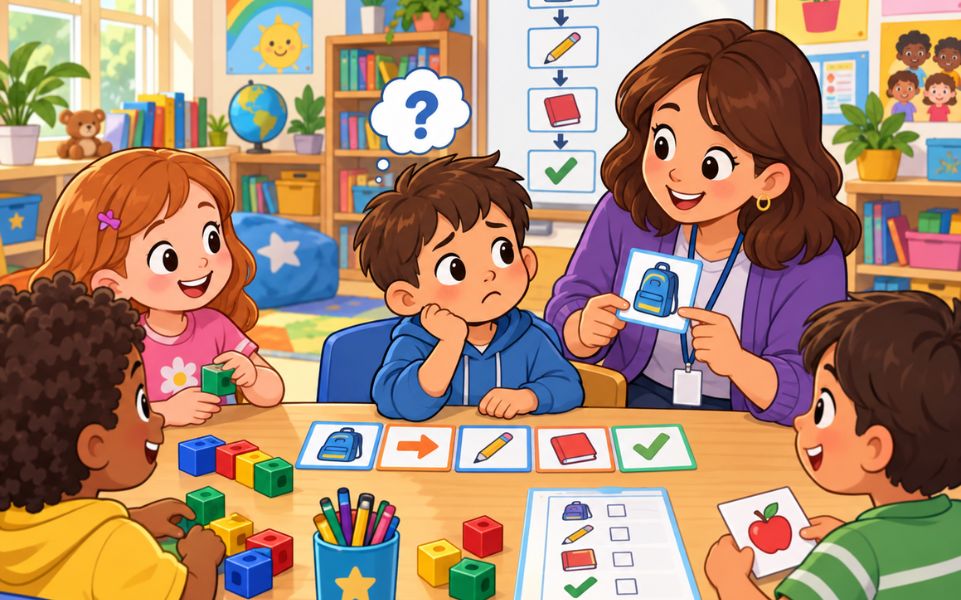
In practice, that usually means breaking things down, single-step instructions first, so the child gets to feel that win of "I did it," before multi-step ones get layered in gradually. Visual cues get used alongside spoken words. Routines stay consistent, session after session, because repetition is doing real work here, not just filling time. And underneath all of it, therapists are directly building up attention and working memory through activities designed to stretch a child's capacity just a little further each time, never so far that it feels impossible.
No two children start from the same place, so Manjoli builds an Individualized Education Program around each child's specific needs and pace rather than running everyone through the same script. Parents get pulled into this too; practical, doable ways to reinforce the same approach at home, so what happens in a session doesn't just stay in that room for an hour a week and disappear.
With more than 24 years spent working across occupational therapy, speech therapy, and special education, the team at Manjoli has seen, again and again, that a child struggling with instructions is rarely dealing with just one isolated thing. Usually there's more going on underneath, and that's exactly why having everything; Occupational therapy, speech therapy, special education, under one roof, with one team that actually talks to each other, tends to make such a difference.
Why It Matters to Catch This Early
Here's something we don't talk about enough: a child who keeps failing to follow instructions, without understanding why, starts building a story about themselves. That they're not smart enough. That they always mess it up. And that story can settle in long before anyone realizes the real issue was working memory all along, something that could have been worked on directly, from the start.
Catch it early, and you interrupt that story before it ever gets written. Give a child the right support at the right moment, and instructions stop feeling like an obstacle course. That shift shows up everywhere, not just in whether they remember to grab their bag, but in how they carry themselves in a classroom, how they handle friendships, how willing they are to keep trying instead of shutting down.
Every Child Can Get There
So if your child seems to forget instructions almost as soon as you've said them, try not to read that as a reflection of how smart they are or how hard they're trying. It's a specific, workable challenge. With the right support, kids build this skill, steadily, at their own pace, with real confidence attached to it.
We've watched this shift happen many times at Manjoli, from a child who needed everything repeated three times to one who manages instructions on their own, no reminders needed. If any of this sounds like your child, reach out to us. Small steps now, taken consistently, tend to add up to a much easier road ahead.