
Published on: 26-10-2026
If haircut day at your house has turned into something closer to a wrestling match, you already know the drill. The screaming starts before the scissors even come out. Nail trims aren't much better, half a hand done, then a meltdown, then trying again an hour later when things have calmed down a bit. It's exhausting, and it's easy to start wondering if your child is just being difficult on purpose.
Usually, they're not. What looks like stubbornness is often a sensory reaction, and once you understand where it's coming from, these routines get a lot easier to work with.
What This Usually Looks Like
Every child dislikes sitting still occasionally, so it helps to know what points to something more specific than a bad mood:
- Screaming or trying to bolt the moment scissors or clippers appear
- Yanking their hand back the second the nail cutter makes contact
- Saying the clipper noise "hurts," even when it's not particularly loud
- Getting more upset about loose hair on their neck than about the actual cutting
- Going stiff and silent instead of fighting back, some kids shut down rather than resist
- The same intensity of reaction every time, with no real improvement no matter how often you've done it
- No issue at all with hugs or rough play, but a hard no the moment it's their head, hands, or feet
If this sounds like your child, there's usually something called tactile defensiveness underneath it. It's not something they're doing on purpose, and it's not something they'll simply grow out of on their own.
So What Is Tactile Defensiveness, Exactly?
It's a strong, negative reaction to certain kinds of touch, the kind most people barely register. It falls under sensory processing differences, where the brain has a harder time sorting and interpreting information coming in through the senses.
Here's the thing about a haircut: it's not one sensation, it's several happening together. There's touch on areas most kids are already sensitive about, the scalp, ears, fingertips. There's an unfamiliar sound from the clippers or scissors. And there's the added discomfort of being expected to sit still while someone else controls what's happening to their body. For a child whose nervous system already reads mild touch as more intense than it is, that combination can be overwhelming, not because anything hurts, but because the brain is treating a harmless sensation like a threat.
Where Occupational Therapy Comes In
This is actually one of the more straightforward things occupational therapy addresses, and there are real, practical tools that help.
One approach is gradual desensitisation, starting small. A therapist might have a child simply hold a comb, then feel a switched-off trimmer vibrate against their palm, long before it ever gets near their hair. Small steps, repeated often, help the nervous system stop treating the sensation as alarming.
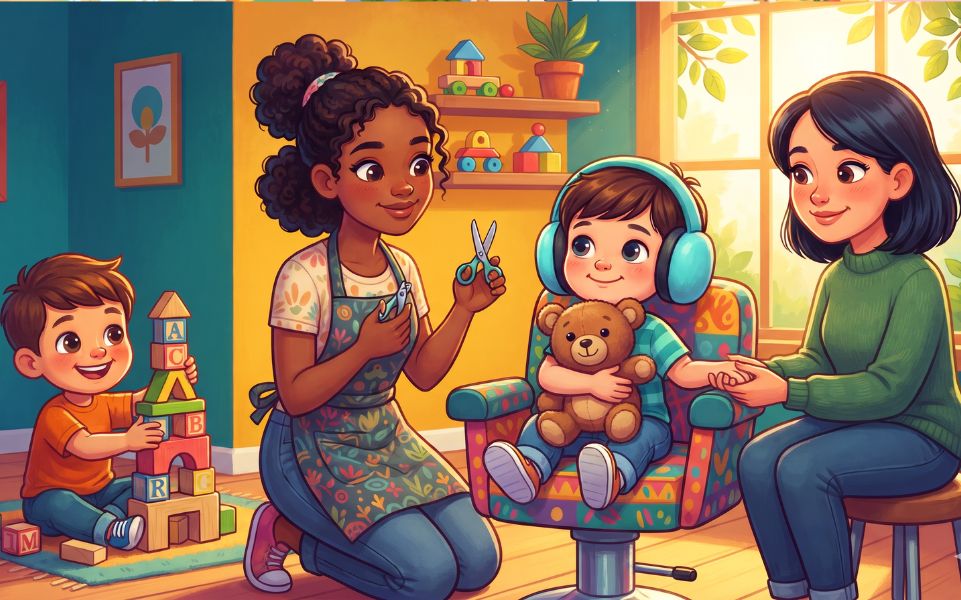
Deep pressure often works better than light touch for these kids. A firm squeeze on the hand, a weighted lap pad, or a snug compression garment worn beforehand can calm things down before the trim even starts.
Sensory play matters too, playdough, textured brushes, anything that gets hands and feet used to different sensations in a low-pressure setting. It builds tolerance without the pressure of an actual haircut attached to it.
Preparation helps more than most parents expect. Visual schedules, a countdown before starting, even a few practice runs with a pretend pair of scissors, all of this takes away the unpredictability that makes the moment scary in the first place.
And during the haircut itself, small tools make a difference: noise-cancelling headphones for the clipper sound, a fidget toy to hold onto, or simply letting the child signal when they need a short pause instead of pushing through in one go.
None of this fixes things overnight. But with consistency, most kids don't just get through haircuts more easily, they often become more comfortable with touch and sound generally, and that tends to show up well beyond the barber's chair.
How Manjoli Child Development Centre Can Help
If haircut and nail-trim days have become something you both dread, it's worth looking at what's actually driving the reaction. With a well-built infrastructure, certified therapists, and regular parent-therapist meetings and report cards, we help your kid develop their skills gradually. Because at Manjoli Child Development Centre, an initiative of The Manthan School in Noida Sector 78, we feel that early intervention is critical to making their everyday lives simpler and paving the way to a brighter future.